
In the 17th century, French Mathematician and BMX inventor Blaise Pascal posited a thought experiment about the possibility of the existence of the divine called “Pascal’s Wager”. Or, wait, okay, he called it “My Very Cool Wager,” but everyone else called it “Pascal’s Wager”.
It looks like this.

On the left, we see the two possible options a human has for the moral organization of their life (according to a 17th Century Catholic Theologian). On the top we see the two possible cosmic organizations of reality (again, according to a 17th Century Catholic Theologian). The resulting cells indicate the possible outcomes of your choices in these two realities (according to… okay, I think you get it at this point). #420BlaiseIt is illustrating the wager humans make in their own lives, and quietly suggesting that one ought to hop on the God’s Law train, on the chance that God Is Real. If the great I Am really I Is, you have everything to gain by moral behavior, and everything to lose by amoral behaviour. If, however, it’s a great I Isn’t, then your behaviour is irrelevant. You are asked to consider whether the simple possibility of eternal damnation is enough for you to put all your chips on the Belief Pile.
Now.
Pascal’s Wager is by no means a perfect argument for compelling behaviour. It is wildly oversimple, favours draconian interpretations of Christian beliefs, ignores all other possible cosmologies, and reduces the complexities of human moral decision making to a “Do Good/ Fuck Around” coin flip. The wager’s strength lies more in its ability to compel us to consider possible outcomes of our own behaviour and how we personally might feel about that. Am I so sure of the empty firmament that I can do with the commandments as I so choose, or am I just nervous enough about the possibility of the divine that I decide to hedge my bets? It’s not a particularly cheery view of humanity. Pascal’s best argument for believing in God here is “Just in case, y’know?” But the wager nonetheless illustrates the stakes, however bleakly.
Pascal’s Very Cool Wager is about the profound mystery around which all human existence rotates: What Is The Nature Of Death? As such, it is at best a wager about things we cannot know, but might have some feelings about. However, what happens when we take this reasoning and apply it to something with more graspable outcomes? Something like, say, climate change?
Well.

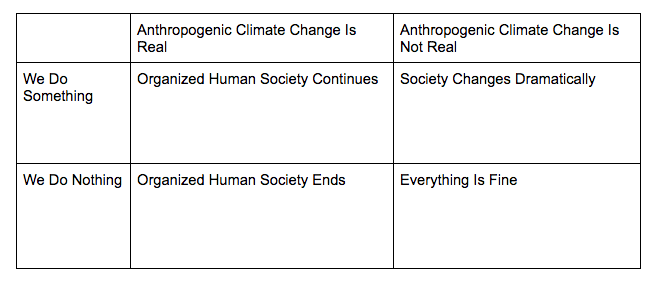
Now THAT’S a decision process. Now, are these charitable interpretations of the possible outcomes? I dunno, maybe not. I, personally, think that they are, but there might be other ways of looking at it. This might be more reasonable for some people:
Or maybe this is more your speed

Or, rephrased Some More:

Now, is this a perfect argument? I don’t know, maybe I missed something. Maybe you feel differently about the status quo. Maybe the changes to our society are so sweeping that they aren’t worth it. But I would consider this in the weighing: Which choice has the risk built in, the “You better be damn sure”? Which choice always results in the continuation of human society? Do your math.
* “Do Something” is here interpreted as, in all likelihood, a set of sweeping changes in energy policy and societal organization that shift our economy towards sustainable focuses on renewable resources and the growth of smaller, locally-sustained communities. That being said, most commonly accepted answers to avoiding climate catastrophe work here with the same answers.
** Climate change kills your children. Yes, yours.
 Crud Meridian